

Patients’ symptoms were evaluated on the Positive and Negative Syndrome Scale (PANSS), a clinician-rated tool used to assess schizophrenia symptoms.2

Positive symptoms2
- Delusions
- Hallucinations
- Disorganized thoughts

Negative symptoms2
- Social withdrawal
- Emotional withdrawal
- Reduced speech

General psychopathology2
- Anxiety
- Depression
- Poor attention

WELTRUZA reduced total PANSS scores across all 3 doses by week 81
*In an 8-week, randomized, double-blind, placebo-controlled study, WELTRUZA met the primary endpoint of change from baseline in PANSS total score at week 8 versus placebo. The least squares (LS) mean changes from baseline to week 8 with WELTRUZA were -21.91, -23.44, and -21.93 for 318 mg, 425 mg, and 531 mg, respectively, versus -12.17 for placebo.3
The power to help improve acute symptoms and sustain improvements across all doses1,3
22.4-point reduction in PANSS total score with WELTRUZA vs 12.17 with placebo (P <.0001)3

In an 8-week, randomized, double-blind, placebo-controlled study, WELTRUZA met the primary endpoint of change from baseline in PANSS total score at week 8 versus placebo1
The least squares (LS) mean changes from baseline to week 8 with WELTRUZA were -21.91, -23.44, and -21.93 for 318 mg, 425 mg, and 531 mg, respectively, versus -12.17 for placebo3
The LS mean differences in change from baseline to week 8 versus placebo were -9.75, -11.27, and -9.76 for 318 mg, 425 mg, and 531 mg, respectively (P <.0001)3,4*
Placebo patients were switched over to active drug in the open-label safety extension phase3
PANSS score change from open-label safety extension baseline to end of study was -7.2 points4†
*Difference (drug minus placebo) in least squares mean change from baseline. For PANSS, a negative value for the difference may represent improvement.3
†Represents all participants who completed End of Trial visit at any time.4

In an 8-week, randomized, double-blind, placebo-controlled study, WELTRUZA met the primary endpoint of change from baseline in PANSS total score at week 8 versus placebo1
The least squares (LS) mean changes from baseline to week 8 with WELTRUZA were -21.91, -23.44, and -21.93 for 318 mg, 425 mg, and 531 mg, respectively, versus -12.17 for placebo3
The LS mean differences in change from baseline to week 8 versus placebo were -9.75, -11.27, and -9.76 for 318 mg, 425 mg, and 531 mg, respectively (P >.0001)3*
Placebo patients were switched over to active drug in the open-label safety extension phase3
PANSS score change from open-label safety extension baseline to end of study was -7.2 points4†
*Difference (drug minus placebo) in least squares mean change from baseline. For PANSS, a negative value for the difference represents improvement.3
†Represents all participants who completed End of Trial visit at any time.4
PANSS total score acute treatment phase chart
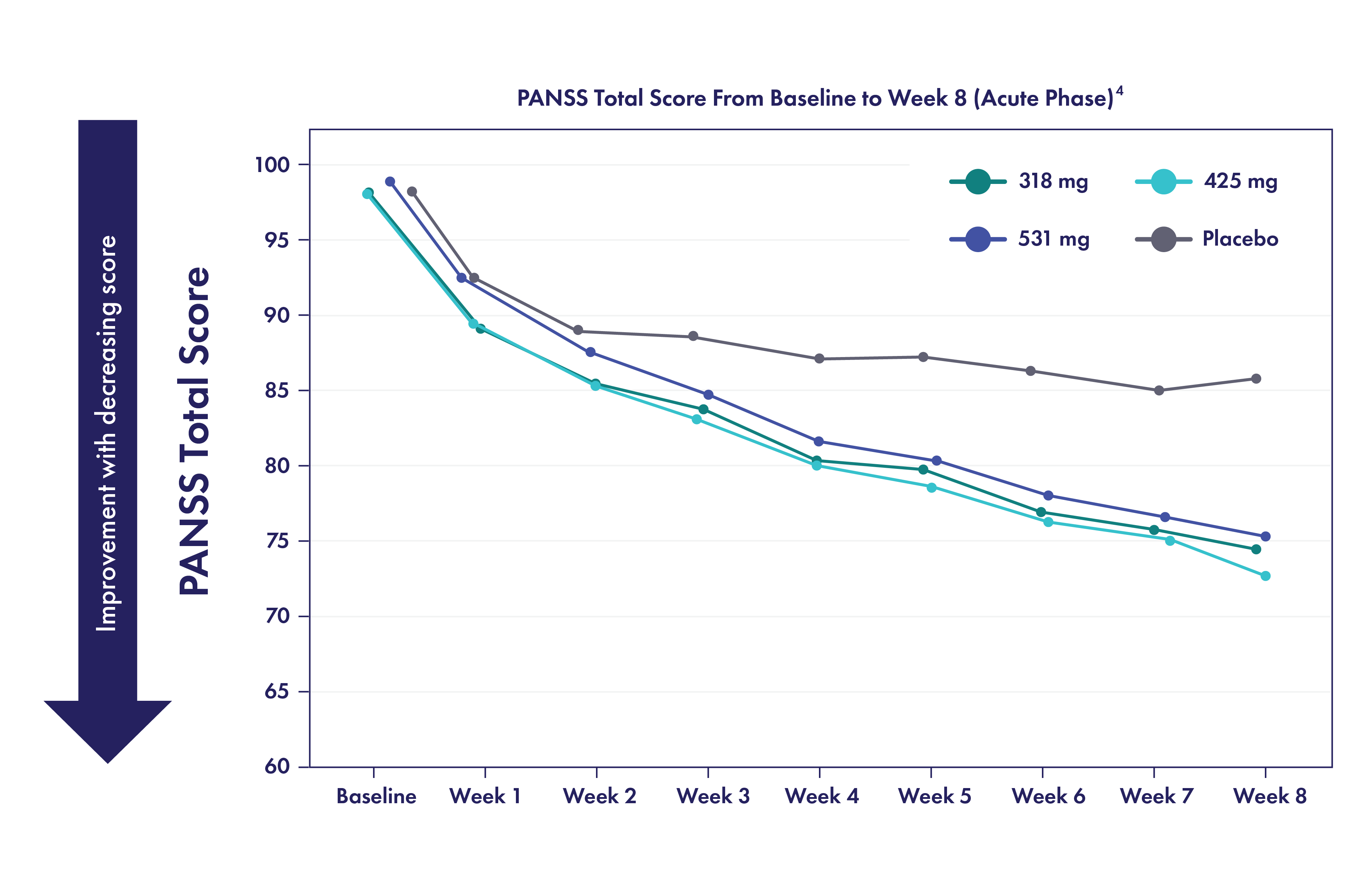

WELTRUZA reduced total PANSS scores across all 3 doses by week 8.1
PANSS total score long-term safety phase chart
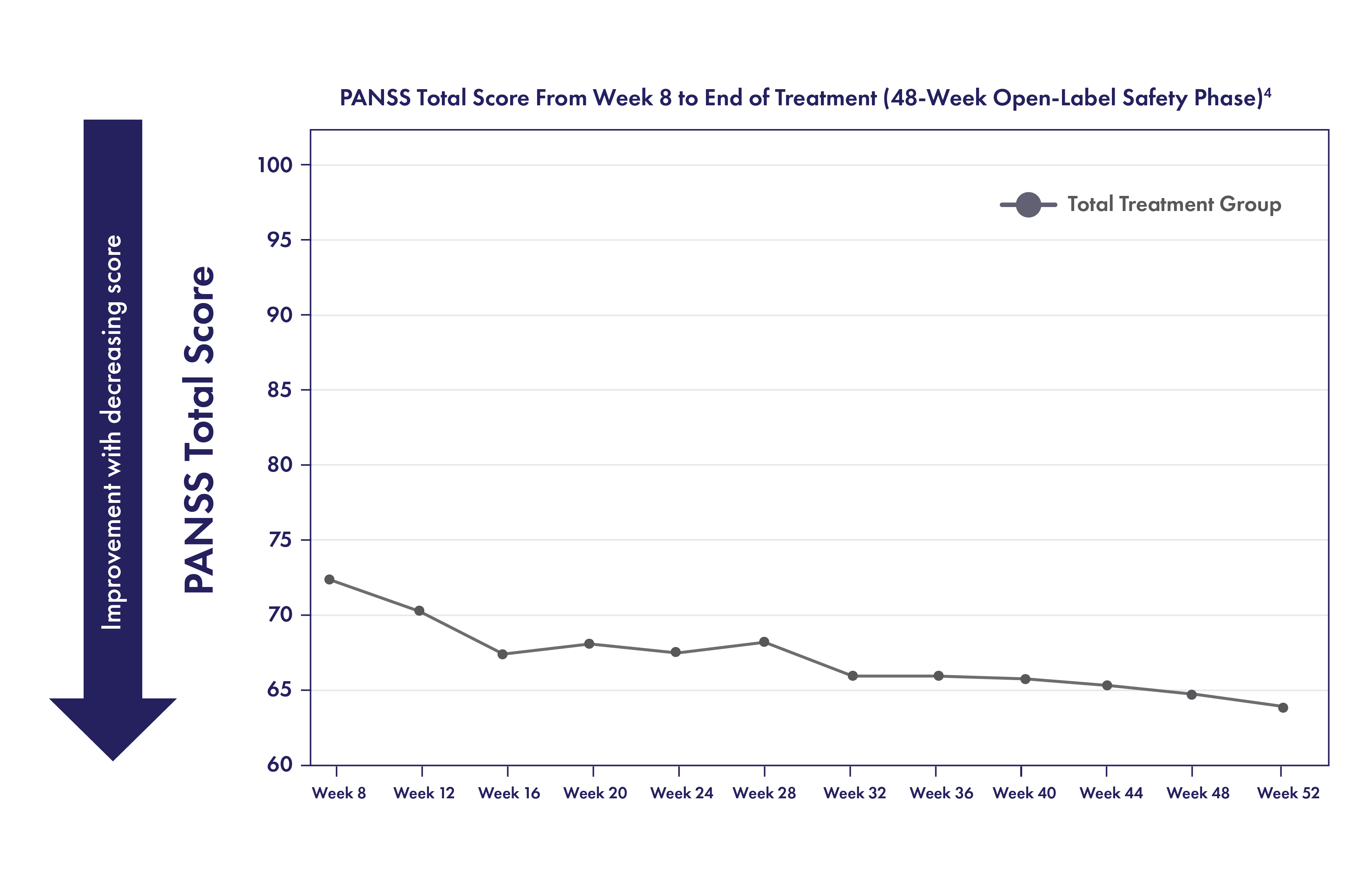
The PANSS score change from open-label safety extension baseline to end of study was -7.2 points.4*
*Represents all participants who completed End of Trial visit at any time.
up next
Efficacy: secondary endpoints
See how patients treated with WELTRUZA experienced improvements in illness severity and personal and social functioning.
SEE THE DATAReferences: 1. Correll CU, Shulman K, Bar-Nur T, et al. Monthly olanzapine extended-release injectable suspension (TV-44749) for subcutaneous use leads to early, consistent symptom improvements through week 8 in adults with acute exacerbation of schizophrenia: phase 3 SOLARIS trial. Presented at: Schizophrenia International Research Society (SIRS) 2025 Annual Congress; March 29-April 2, 2025; Chicago, IL. 2. Kay SR, Fiszbein A, Opler LA. The Positive and Negative Syndrome Scale (PANSS) for schizophrenia. Schizophr Bull. 1987;13(2):261-276. 3. WELTRUZA™ (olanzapine) extended-release injectable suspension Current Prescribing Information. Parsippany, NJ: Teva Neuroscience, Inc. 4. Data on file. Clinical Study Report. November 2025. West Chester, PA: Teva Neuroscience, Inc.